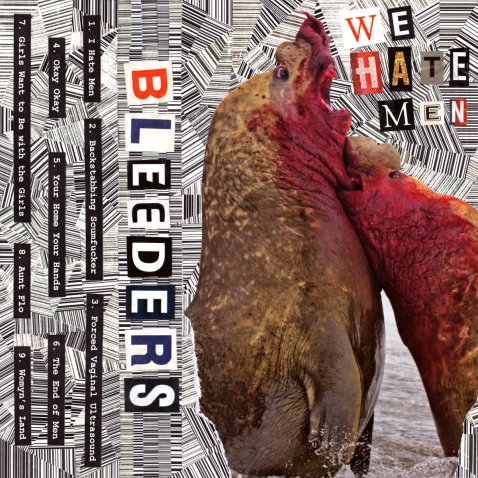
Anti patriarchal pro femme photo punk from the PA outfit, BLEEDERS. from Miami’s Crass Lips Records Intro track “I Hate Men” starts out in the perfect foot forwad for smashing the patriarchy, Angular guitar, punchy, punded drums, and screamed / yelled “crew style” on the chorus of “I Hate Men” prove you do have to bash a man in the side of the head about fifteen times before you get a small enough crack for anything to sink in, but when it does, for 4/4 punk, this is the type of ear blood you want dripping into your brand new headwound. Super fuzzy and distorted sounding recording, but the playing is phenominal, and for the style its done super well and interesting. Straight up all women/non pinary proto punk stylings churn out three heavy and guitar/vocals forward tracks of pure misandry! It’s fantastic! Other track titles such as “Backstabbing Scumfucker” and “Forced Vaginal Ultrasound” don’t let the listener map their own confused musings into these tracks, they are exactly what they are and don’t need to be interpreted, if you have an ear, you’ll get it, if shit clogged canal is how you roll then move right along and await the eight am ding of the churchbell for the three thousandth time (to go away)
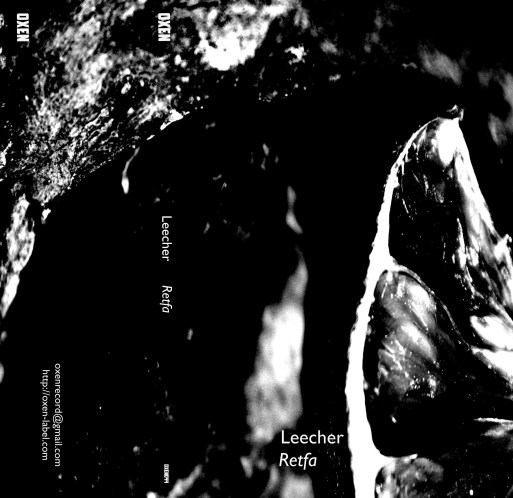
Oxen Records is becoming one of North America’s prominent labels specializing in harsh noise, and a short cassette from their newest batch, featuring Tokyo’s Leecher project delivers just that! Two full sides of technically, flawless, sharp, soulless harsh noise blasts. Leecher has the chops and isn’t afraid to use the listeners inner ear ear canal with a digital thrust of blasting, blistering, shattering vaces of harsh noise.
Leecher builds a masterful composition of cascading heavy and difficult harsh music on the A side, masterfully leaving plenty of space for the sharp shredded sounds to do their damage and decay before the next big event slams the listeners head through the speaker cone once again; it’s time for high frequency brain modification techniques, and Leecher will be administering the tests today folks.
The B Side is Just as noisy and chaotic, though considerably less dynamic, while overall offering an equally loud and punishing composition, with much more of “live” feeling and movement. A different kind of sonic kinetics. If the A Side was the lead in to the death of consciousness and growth of disorientation, the B side is the accumulation of every negative thought and emotion thrust into a whirring, spinning, spitting sonic fireball which again and again crashes into the throat while simultaneously exiting through the ear. The B side is most likely a live performance, however lacking in intensity is not something that needs to be mentioned, as the energy that was present or absent in the room during this recoding, without a doubt transfers it’s manic, spitting energy info this cassette for the listener to enjoy in a self-loathing aural assault. This is noise music for true noise music, not for car commercials, not for sound design, not for gallery window installations just for cold unrelenting noise itself.
Menacing, torturous screams echo and decay over sharp pillars of white and pink noise, with shifting amplitudes of chaotic sputtering’s and groans of agony, bleed and squeeze each other to bits with constant regurgitation, to add to the general uneasiness and confusion of this release, the listener never knows when the end Is near, and when they will be hit with a sonic hammer. Is it over? I don’t think it’s over unless it’s the ear once again feeding back into itself after twenty minutes of harsh, tenuous pulses of harsh noise feedback. Leecher operates his devices like a manic surgeon hopped up on his own supply and ejecting, dense, dark noise blasts in every direction, which a morbidly confusing and disorienting array of precision. Leecher is precision noise, and if you fancy the harsh side of things, GO BUY THIS TAPE NOW.
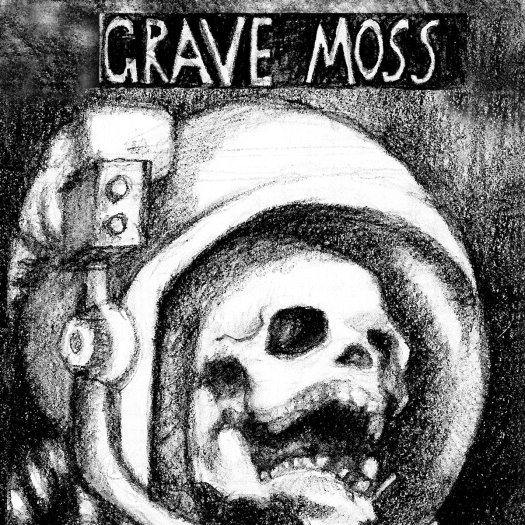
Grave Moss play fuzzed out psychedelic lo fi synth punk/rock/death/doom/comedy/sludge. But it’s not really that, but it kinda is? The label whom released this short little ripper of a cassette, Crass Lips Records, is just as all over the map in a great and eclectic, but uncontrived way. Sabbath mock band? Perhaps, but it sounds damn good? I think? I can’t tell my mind seems to be altered by some gooey, slippery off blue fungi, that could only be described as one thing; mosswave. Borrowing equal parts from Chrome, Black Sabbath Volume 4, Sisters of Mercy, and a broken Yanni answering machine greeting, Grave Moss create a style of deathrock that is both comical and serious, lighthearted and menacing, heavy yet gurgling with comic relief, nauseous yet satisfied. Drugged out, fuzzed out, mold puffed riffs, cavernous percussion, and angrily sneered vocals are the go to weapons of Grave Moss. The hammering guitar makes you split your head open like the village wino running circles until he spins out his blood and collapses from disorientation.
Oscillating between synth-driven death rock, dirged -out pop power chord progressions, scraping their way to the bloody tip of the mix, flustered with doubly duty screeched/howled vocals to boot. The falsetto voice it’s so low oscillates sub bass gurgle for an accentuated evil grin. Almost sounds like it could be mocking early Christian Death in the laugh out of the side of your mouth smile slicer. This is fun music to discuss how much Death in June is not that interesting, whilst keeping awake at the wheel to the next five-hundred-mile marker of death. Driving music to vomit to all whilst still head banging, this appears the aesthetic of Grave Moss Probably a laugh-treat live if they play it up to the absurdity of these recordings. The thickly churning bass lines and bass/lead synth parts glue the low end perfectly together to belch to thick, quivering sound, a tonal, dissonant, and slightly comical versions of alienating guitar and synthesizer riffs, pummeling bombastic percussion chugging away like the ergot beneath the old wooden keg nobody would dare drink out of, sans the drummer. Infected sound, stitched side to side through the singer’s flanged out, chopping, angsty barking fits which are hurled at the listener like a rickety crossbow, and with a creaking, sinking, smelly, ship collapsed into a swamp of disease and mutation, the sound of GRAVE MOSS is complete.
Big boatload of tapes just arrived from Crass Lips Records, Miami based home imprint cranking out dozens of releases monthly operating mainly outside of the mainstream bore patterns of music industry hogshit. There’s a plethora of noise, experimental, punk, lo fi pop , garage et al plastered throughout the labels discography, which you can take a peek at here at their bandcamp .
The casuality the label takes is a refreshing return to almost a tape trading aesthetic where inserts don’t really fit, home xeroxed art crammed into recycled cases, but the music is the message,not the medium. In an era where everything is deluxe this and that, it’s nice to see a label taking a more primitive approach. The Richard Gumby cassette which arrived, which I believe to be self titled covers thirty or so minutes of mangled, floating, ballooning deconstructed pop music blending spoken word, home brewed collage and sampling techniques between fuzzy, whined vocals not so far off from a natural blending of pre Spacemen 3 outtakes, early John Dwyer era pop punk, and even a country-ish influenced ballad to boot, which could easily spark the interest of an early Silver Jews fan or two, on Richard Gumby, even within a certain song, a number of artistic pop styles are buzzed through almost like primitive radio scanning needle techniques at times even at a near feverish pace, and the fidelity and pacing lend the listener ‘a chair in the room at the end of the hall’- style voyeuristic approach to this quaint, lush, mangled and warped pop songs. For a short tape, Gumby covers a wide range of vocal and instrumentation styles oscillation between lush, dreamy pop and broken whirring slightly out of key music boxes, tastefully used percussion and synth, with even some noise/glitch sections to boot, with a surprise double bass break down with chopped/screamed vocals and some pretty intense screams to boot for an album that boasts mostly pop offerings Honestly, sort of a hard to classify release, check it out for yourself here. Weird stuff. We can say for sure haven’t heard much like it. Check the track, “Simon Said”
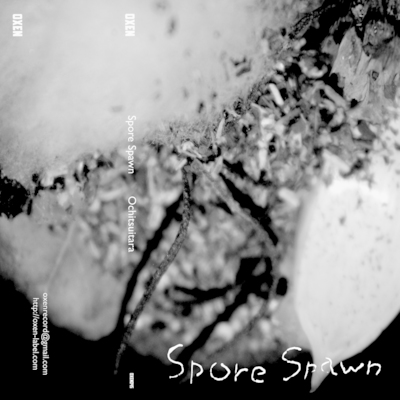
Spore Spawnis a nearly decade old project based out of Japan, and also happens to be an end level boss in the popular fan favorite video game, Metroid.
The project name choice is Probably not an accident based on the title and aesthetics of the artists imprint, 16 Shots Per Second but this cassette is released by Leah and Matt’s imprint OXEN, based out of LA. “Ochistuitara”, from Tokyo’s underground legend SPORE SPAWN, boasts a twenty minutes’ sacrifice of masterfully crafted, exciting, kinetic, dynamic harsh noise, and supposedly is made from a myriad of homemade joystick synthesizers and crude noise devices. While essentially existing in the harsh noise realm, “Ochistuitara” actually covers a rather wide and refreshing array of harsher sounds, compositional strategies and dynamics, and even musicality at times, almost a virtuosic approach to harsh noise. Spawn creates dense walls of feedback that violently and aggressively cascade into spacious vignettes of ambient drone, expertly blended field recordings, slow rhythmic pops, and chirps like a glitched- out, off-kiltered, dying alarm clock that fights the plug to stay in the wall when it’s angrily yanked out. The walls of blistered, busted out, serrated chaotic mayhem crescendo into utter sonic chaos, and just as the ear bleeds for mercy rescind into a cold, alienating, isolating hum. At times, the ambient sections act as a break from the unrelenting mountains of noise, and other times, function as matrix of brain mutes with respect to the ear fatigue. Loud is only loud when quiet is quiet, and on “Ochistuitara”, the artist is no doubt conscious of this strategy in respect to the timing and composition of this EP.
Things never stay the same to become predictable or flat, Spore Spawn is constantly shifting though wavetables of disorientation, fear, chaos, tension, and even a few brief moments resolve. The tones themselves have a cold, digital body, while swells of analog chaos modulate themselves and the sharp digital pillars of extreme sonic swells and decays, and the start /stop style of aggressive noise, on more than one occasion even function as a “drop”. What was dropped we don’t know, however it carved a deep impact into the ear canal, even noted on one of CLIPPING‘s year end best of lists! In short, this is a must have for fans of ASTRO, K2, early MERZBOW and even some of the work of CLIPPING themselves. OXEN continues to remain at the forefront as one of America’s most aesthetically and conceptually consistent harsh noise labels. Grip this fantastic tape before it’s too late. Here’s a few world from OXEN that represent the complexity and brevity of this EP flawlessly,
“Ochitsuitara brings any fan of modern harsh noise (nostalgists won’t be disappointed though maybe not specifically catered to) closest to articulating what it is that sets Spore Spawn apart from decades of legendary noise pioneers, his modern myth building utilizing swirling loops of cacophony and squelching stabs, uncompromisingly outpacing any modern competition in his unique patterns of ecstatic jarring drunken fervor and (sometimes) vocal delivers closely woven into and through electronics culled from homemade disused gaming controllers. Just harsh as fuck. All measurements of harsh noise enjoyment of this genuinely gifted noise artist will be vastly rewarded and on abundant display on Ochitsuitara.”
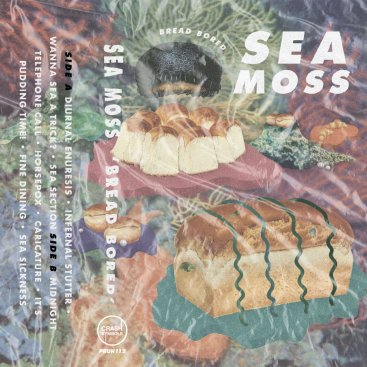
SEA MOSS is a perfect example of why duos are sometimes the most engaging for heavy and experimental music. SEA MOSS, splice all of the specific aspects that make duo’s so special; tension, dynamics, a call and response/push pull type of dynamic, (that often gets lost or muddled once a third or forth voice is added), into a fever dream ritual of distorted noise rock, and rhythmic, percussion heavy noise. When contrasting voices push and pull, interesting and chaotic things can happen, and that’s exactly what this Seattle duo does, on their freshman album “Bread Bored”. For one, the sound is a perfect blend of Noa Ver homemade, noisy, chaotic, dynamic home-brewed synthesizers, which she popularized in her solo project Mulva Myasis and Zach D’Agostino percussion and live sequencing which meld together perfectly to create a raw, cacophonous blend of abstracted, cut up, angular noise / rock. Noa Ver create walls of glitched-out, sputtering, chirping, regurgitating bent and mangled waveforms blending together to create rhythmic walls of unique, raw synthesized noise over D’Agostino, who belts forth a seemingly endless array of broken rhythms, fusing both analog and digital sources to create a chaotic, chopped up, backbone of heavy, flipped out perscussion. Also we couldn’t really talk about this release without mentioning the intricate, dense, psychedelic collaged cover art/Layout done by Liz Pavlovic, offering the perfect visual counterpart to the dense, tripped out, broken sounds of SEA MOSS.
Having seen SEA MOSS live in 2017 (and BTW this project is barely a year old, and has already toured, released this album on CRASH SYMBOLS and self-released several live recordings) I had a rough idea of what to expect from this tape, and it really represents their live sound well. The aptly titled “Bread Bored” oscillates between more noise, even free jazz styled works, using more chopped, off timed rhythm tracks, and the synths are sputtering more like a trumped or saxophone than a synthesizer, such on the second track “Infernal Stutter”, whereas the very next song, “Wanna See A Trick?”, perhaps my personal favorite on the album falls much more into an early Load Records style of noise rock where the synths and walls of noise act as a heavy low end for the pummeling 4/4 breakdowns which dominate the song, or similarly styled and varied is the finale “Sea Sickness”, which blends thudding drums, more buzzing, screaming oscillators and time/tempo changes that will leave your head spinning, There’s also a whole lot varied vocal styles which range from long swelled, yelling to short, antagonistic bursts of sound, yelling, fighting , screaming, screaming, threatening, impactful, and sharp in unique ways even though the lyrics are rather indistinguishable from each other. Despite this, the vocals provide an additional layer of tension and chaos, especially when complimenting the heavy, smashed out percussion riffs in a sort of call in response type of way. At times, it’s as if all the instruments are being played as their opposites; or something they’re totally unreleased to; synths are played as horns, drums are played as basses, vocals are an additional layer of percussion, but also so much more.
SEA MOSS stands above and beyond a lot of other offerings in noise rock camp so far for 2017 that have pummeled my ears. SEA MOSS has a seemingly uncanny ability to pack three or four different styles and feelings, even within a single track (and mind you most of the tracks are under four minutes, some even in the one to two-minute range). This music could be from 1999 or it could be from 2199, we haven’t totally figured that out yet, and that’s part of why it’s intriguing. The cassette is sold out; however, you can grip the digital album for five dollars from the Crash Symbols band camp page. Be sure to check out a myriad of other releases from the West Virginia based imprint, while you’re on the band camp and make sure to follow SEA MOSS here!
SEA MOSS is a perfect example of why duos are sometimes the most engaging for heavy and experimental music. SEA MOSS, splice all of the specific aspects that make duo’s so special; tension, dynamics, a call and response/push pull type of dynamic, (that often gets lost or muddled once a third or forth voice is added), into a fever dream ritual of distorted noise rock, and rhythmic, percussion heavy noise. When contrasting voices push and pull, interesting and chaotic things can happen, and that’s exactly what this Seattle duo does, on their freshman album “Bread Bored”. For one, the sound is a perfect blend of Noa Ver homemade, noisy, chaotic, dynamic home-brewed synthesizers, which she popularized in her solo project Mulva Myasis and Zach D’Agostino percussion and live sequencing which meld together perfectly to create a raw, cacophonous blend of abstracted, cut up, angular noise / rock. Noa Ver create walls of glitched-out, sputtering, chirping, regurgitating bent and mangled waveforms blending together to create rhythmic walls of unique, raw synthesized noise over D’Agostino, who belts forth a seemingly endless array of broken rhythms, fusing both analog and digital sources to create a chaotic, chopped up, backbone of heavy, flipped out perscussion. Also we couldn’t really talk about this release without mentioning the intricate, dense, psychedelic collaged cover art/Layout done by Liz Pavlovic, offering the perfect visual counterpart to the dense, tripped out, broken sounds of SEA MOSS.
Having seen SEA MOSS live in 2017 (and BTW this project is barely a year old, and has already toured, released this album on CRASH SYMBOLS and self-released several live recordings) I had a rough idea of what to expect from this tape, and it really represents their live sound well. The aptly titled “Bread Bored” oscillates between more noise, even free jazz styled works, using more chopped, off timed rhythm tracks, and the synths are sputtering more like a trumped or saxophone than a synthesizer, such on the second track “Infernal Stutter”, whereas the very next song, “Wanna See A Trick?”, perhaps my personal favorite on the album falls much more into an early Load Records style of noise rock where the synths and walls of noise act as a heavy low end for the pummeling 4/4 breakdowns which dominate the song, or similarly styled and varied is the finale “Sea Sickness”, which blends thudding drums, more buzzing, screaming oscillators and time/tempo changes that will leave your head spinning, There’s also a whole lot varied vocal styles which range from long swelled, yelling to short, antagonistic bursts of sound, yelling, fighting , screaming, screaming, threatening, impactful, and sharp in unique ways even though the lyrics are rather indistinguishable from each other. Despite this, the vocals provide an additional layer of tension and chaos, especially when complimenting the heavy, smashed out percussion riffs in a sort of call in response type of way. At times, it’s as if all the instruments are being played as their opposites; or something they’re totally unreleased to; synths are played as horns, drums are played as basses, vocals are an additional layer of percussion, but also so much more.
SEA MOSS stands above and beyond a lot of other offerings in noise rock camp so far for 2017 that have pummeled my ears. SEA MOSS has a seemingly uncanny ability to pack three or four different styles and feelings, even within a single track (and mind you most of the tracks are under four minutes, some even in the one to two-minute range). This music could be from 1999 or it could be from 2199, we haven’t totally figured that out yet, and that’s part of why it’s intriguing. The cassette is sold out; however, you can grip the digital album for five dollars from the Crash Symbols band camp page. Be sure to check out a myriad of other releases from the West Virginia based imprint, while you’re on the band camp and make sure to follow SEA MOSS here!
With the rise of accessibility for artists and producers to create sound, music, art and the ability for those artists to contextualize, and re contextualize their work in a seemingly often dizzying whirlwind of labels, sub-labels, sub-labels of sub-labels, through, you guessed it, the INTERNET; questioning the role or necessity of a small independent record label in these weird, confusing post-post modern days of malleability of meaning, format and intention, seems like probably a good idea. How many of them are genuine, how many of them truly put the artist first, and in priority, how many of them believe and stand behind their “product”, behind both the “artist” and the “artwork”. Derek Rush‘s New York – based imprint, Chthonic Streams does just that, and they do it with style, focus, and intention, as exemplified by the labels’ most ambitious and potentially most conceptual release to date, at least in its packaging and form, is the “No Workers Paradise” boxset. You should keep reading, but what I also recommend is that you stop what you’re doing and instantly ORDER THE BOXSET HERE!
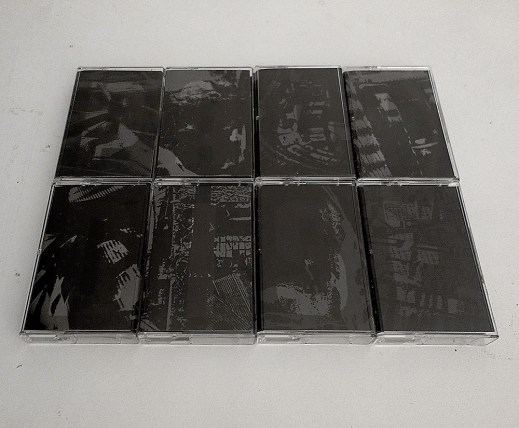
We are fans of boxsets, we are fans of conceptual art, and we are fans of toolboxes and ridiculously ambitious projects here at Decaycast, and Chthonic Streams exhaustive 8 hour cassette boxset titled, “V/A: NO WORKERS PARADISE” covers all of these bases and more, in one, mechanical, maniacal offering. Boxsets are awesome, and they’re even more compelling when they actually contain new material, by, gasp, even living artists. No shade on the myriad of Miles Davis and John Coltrane CD reissue boxsets that we have all seen and probably purchased, but eight hours of new material, from eight heavy hitters in the noise/industrial/power electronics scene enclosed in a matte black tool box, accompanied by a zine and customized time card to boot, is not really something we could (or should ignore). We received a rather large media mail box from New York and upon opening, the “No Workers Paradise” boxset emerged, a sleek matte black toolbox with a shiny chrome latch and basic font that reads “No Workers Paradise” is affixed to the top. Its interior reveals eight 60-minute cassettes and a zine/accompanying booklet for the release, and customized time card emerge as the tools for the job, so to speak. It was time to clock in.
As with all of the labels’ releases, the artwork is done by label head honcho Derek Rush who also books shows, is an active DJ, and works in graphic design and photography, so it comes as no surprise that all of the artwork included looks stunning and professional, accented by the printed booklet and cassette artwork itself. We haven’t even gotten into the sounds and this is already worth the $75 price tag without question, a truly beautifully put together collection. Now into the meat and bones of these disgruntled, bloody and beaten-down workers, we will delve into the sounds in reaction to the tormented work day!
The boxset starts with the label owner’s project, COMPACTOR, offering a strong, mechanically styled “old school” feeling industrial track with clanging rhythms, backed with the tick tock tick tock of the overlord’s clock. The panopticon is omnipresent and the worker must continue. Wake up. Work! Time To Work! Until you DIE, and DIE, until you can clock out at the end of the day and do it all again. Compactor’s sounds generally fall within a more mechanized style of industrial, there is soul, but it’s the soul of a robot programed to destroy itself, through repeated, violent, senseless rhythms, yet Rush’s sound and sample choices are powerful and intentional. The, slow, churning blown out percussion blends perfectly with the high squelching feedback of industry/insanity and multi-layered, multi-timbral synth workings. Compactor’s offering is the perfect opening to the project, cold, alienating, mechanized, and dense; the perfect ramp up to the more fuzzed out, abstracted works of some of the other contributors to the boxset, The Vomit Arsonist, Redrot, Gnawed, and Filth, amongst others.
Another standout sound work in this massive offering comes from Denton, TX’s FILTH, who offers up his own interpretation of an hour slice of the standard american work day. Rob Buttrum’s FILTH project is known for his menacing cacophony of industrialized noise, power electronics and analog psychedelic compositions. FILTH brings his A game to work for with a dark, brooding, menacing stitching of fuzzed out, psychedelic noise and drenched in feedback power electronics, in what can only be described as the FILTH sound, which we have covered in the past HERE in an interview with Buttrum and his label OUT OF BODY RECORDS. Buttrum does offer a rhythmic backing at times, but in a different, slightly more diffused, muffled style than COMPACTOR, but don’t skimp on the manual, because there is a harsh reality in store if you don’t, and you’re likely to get gobbled up into the machine and spat out as puny remains, but FILTH’s sound is not exclusively harsh, tripped out noise, there are abstracted broken rhythms, there is intention, it is planned, and panned, it IS the sound of the second hour of the day forcing itself into the negative space of your brain, that may in fact, prove to be your last of the day, of your life. FILTH is the sound of a rusted, dilapidated, unstable, harsh machine taking its unknowing operator with it to an early grave. Planned obsolescence, like user, like machine.
Michigan’sREDROT (Chondritic Sound, Bloodlust, Slaughter Productions)aka Ryan Oppermannoffers another standout track on “No Worker’s Paradise” with one of their tracks titled, “Work Release Program Terminations”. REDROT is blackened, harsh noise/PE, with slices of blown out beats, and angular rhythmic structures over a sea of dense power electronics and industrial. The machine has already regurgitated the one time worker into a mess of fleshy, red, sacks of rotting remains, and REDROT is the absolute perfect soundtrack to the coworkers slowly and confusingly sweeping the bloody bits into a bag for disposal. Redrot carries a white noise sword which swiftly and steadily shaves away at the listeners inner ear canal, until a drop of blood leaks out, and starts a mechanical frenzy leaving the workers, along, confused, and scared as the drop turns into a red pool where music dies.
Another standout offering on this project is Minneapolis, MN’s GNAWED, aka Grant Richardson. We’ve covered one of GNAWED’s previous releases HERE on Decaycast.
GNAWED‘s track for “No Worker’s Paradise” is similar to his other industrial, harsh noise, power electronics hybrid funeral stylings; chaotic, yet restrained, busy yet articulate, harsh but at times even beautiful. Much like FILTH, GNAWED uses homemade analog electronics to create a brooding, dark, cavernous sound all of his own. His “Terminal Epoch” album from Phage Tapes, would be the closest style wise that I’ve heard for the track for this boxset. GNAWED is a master of tension through intentional and articulate dynamics, balancing sharp, harsh sounds with lower, more brooding under swellings of terror; the track slowly and painfully oscillates between violent shudders, chaotic, dense, noise blasts and distorted, broken voice swells.
THE VOMIT ARSONIST,EXISTENCE IN DECLINE, BLSPHMand WORK/DEATH also punch in with powerful sound works blending industrial, harsh/blackened noise, power/electronics and dark, experimental moods of the harsher, angular style.
The boxset as a whole is a lengthy listen clocking in at the 8 hour mark, but when one thinks of the slow, grudging, unrelenting time clock of the american work day, this tour de force of harsh industrial / PE serves as a warm, relaxing day on the beach as a vacation, even for a day, from the alienating, hellscape robotic world that is American capitalism. Rush does right by all of the artists involved with stunningly beautiful and appropriate artwork and packaging as with all of the labels releases. A must for any noise collector, and/or hater of capitalism.
DECAYCAST Premieres: Fire – Toolz Premieres Video for “PASSAGEWAYS TO MEETING AREAS” Plus Interview with Angel Marcloid
FIRE TOOLZ “Interbeing” Cover Art on Bedlam Tapes (2017)
Angel Marcloid makes music and art under the Fire – Toolz moniker as well as other active projects such as MindSpring Memories , Angelwings Marmalade , and the now defunct Power Windoze, runs two imprints, Rainbow Bridge, a long standing physical editions label based out of her hometown of Chicago, formerly Baltimore, MD as well as running the net label, Swamp Circle .
For one of her newest releases on Bedlam Tapes, Angel has offered a nearly forty minute offering titled, “Interbeing” which was released this November and today we are beyond excited to be premiering a video for the track, “Passageways To Meeting Areas “, which is a masterful work of aural and visual assemblage, oscillating between dense electronics, noise, industrial, smooth jazz and other more esoteric, less definable physical, visual, and aural points of reference and strategy. We are very proud to be debuting this video here and honored that Angel took time to talk to us more in depth about her processes as an artist, influences, and scoring weed on the internet. Here’s the video, and interview below! Please support Angel and buy her music, looks like the cassette version is sold out but you can cop the CD Version and a free digital download of “Interbeing”HERE!
Hello Angel. Thanks for chatting with us over the panopticon that is Facebook messenger for Decaycast, first off how is your day going today and second, how deep does the internet go? Is it a weird portal? Just data? Productive? Evil?
My day has been pretty good. I was at work for a while, which was a good time. (No sarcasm, I swear.) Then I came home, fed the bears, scooped their shit into a bag, and started making the final tweaks to an LP slated for release next year.
About the internet’s depth…all I can say is that if you go deep enough, you can get fantastic weed for good prices. As a self-proclaimed hermit, ordering anything online is a blessing.
I remember we used to have to wait in the dumpster behind McDonald’s, now you can order weed online. What a trip? It’s a rare case when someone has a good day at work, so this is off to an odd but wonderful start already. Do you want to talk a bit about the LP you’re recording?
It’s a Fire-Toolz record, and it’s called Skinless X-1. Only about 30% of the music has vocals in it this time. I wanted the melodies and textures to have a little more space to breathe and say their piece. There is an even heavier 80s/90s new age & jazz fusion influence on this album. I still can’t seem to get away from heavy four-on-the-floor beats, though. With the exception of one eccojam, the occasional sample is only used as a brief brushstroke. I tried to write music that sounded the way my dreams did when I was young, living at home, in a peaceful part of town, surrounded by trees, grass, swamps, and various wildlife. This isn’t to say the album doesn’t have plenty of abrasive moments. I will say that there is no anger on this album. I’m still exploring personal challenges, but they’ve been a little neutralized.
This album’s message is more observational, more curious about things, and frankly more empathetic and compassionate toward a lot of the things I’ve expressed mind-numbing rage for on previous releases. This album expresses a deep appreciation for things, and an outlook that is a little more neutralized. The album is floaty. And the few times it lands, it really pummels into the ground. The mess it leaves is intricate and colorful. Am I doing your job now? I’m starting to say some weird shit.
I love the idea of it smashing into the ground and leaving this colorful mess. Can you talk a little bit about some of your previous releases or projects that stood out to you or hold a certain place in your scope as an artist/ person
Most of the releases in my backlog that stand out to me are ones I didn’t think were going to stand out the way they do. A lot of times my favorite releases aren’t favorites of others. Which is fine, but interesting in it’s own way.
I had a CDr/6″ lathe/cs release called “Solar Activity & Civil Unrest.” It was massively conceptual. There was a pretty wide variety of experimental electronics, tape manipulation, found objects, voice, etc.
There was another release called “Journey To 0.004”that had several editions. It included an hour long sound collage. Also a concept release. I think these types of long releases can be exciting for the artist and overwhelming for the listener.
Both of those releases are available for free download and were released under my old birth name, “Justin Marc Lloyd” on my old label Rainbow Bridge.
Lastly, my music as Power Windoze didn’t really get much attention compared to some of my other work, but I believe it to be very special. It was my first attempt at making electronic music entirely on the computer. I released a few albums and an EP. The second album may come out on vinyl. I just started talking to a label about it. It’s about 3 years old now and needs a remaster, but I’m excited that the album might reach a wider audience soon!
I need to dig into that PW stuff. You also run a Netlabel, Swamp Circle? Care to talk a bit about that and the benefits / limitations you’ve experienced as owning both physical and digital imprints?
I started Swamp Circle for two reasons. I wanted to release my music and other people’s music without financial limitations (on my part or theirs). I also wanted an outlet for my own digital artwork (Rainbow Bridge was mainly a xerox-on-colored-card stock label). At first I wanted to release 5 albums at a time. Now I just sort of release them when I can. Most of the albums in the queue right now are other people’s music. We are waiting on me to finish the artwork. And since my priorities have shifted, it’s been challenging to find time to do this artwork. I made a rule for myself that all art on Swamp Circle would be done by me. This was cool at first, but now I’m mega behind because I gave myself another hefty job to do. I’ve been thinking about changing the format but I’m not sure yet. It’s rare a donation is made so it’s not financially lucrative, but it was never really supposed to be. I wanted these releases to be free.
Well we hope you keep Swamp Circle and Rainbow Bridge going, they are both fantastic labels. Care to talk a bit about your influences as an artist; bands, songs, routines, strategies, etc?
This past year I’ve been infatuated with jazz fusion-tinged new age music from the 80s and 90s. Shadowfax, Jonn Serrie, Patrick O’ Hearn, Dan Siegel, Elements, Richard Souther, Interior. You can hear some of that influence on Interbeing, and it will be even more apparent on Skinless X-1. Orange Milk releases are always in regular rotation. Euglossine, Nico Niquo, Seth Graham, Giant Claw, and Loto Retina are all especially inspiring artists to me. BT’s “This Binary Universe” was a recent rediscovery that kind of knocked me off my feet and provided a huge boost of creative juju at one point in the Skinless X-1 writing process. When composing sound collages, I’m reminded of my roots in Sickness, Gastric Female Reflex, Jason Lescallet and other noisers that are incredible at keeping you confused and overwhelmed. Fear Factory, Nine Inch Nails, and KMFDM have been there for me since I was a child, perpetuating my tendency to make heavy electronic music even when I don’t want to. John Wiese and mid 2000’s Prurient, although vastly different artists, taught me a lot about harsh textures and their unique aural impact. Also, tinnitus. Tinnitus influences me as an artist.
My routine usually starts with an isolated idea. Never an idea for a whole song. That idea is usually recorded or assembled, and then blindly built upon by living in the moment and just doing whatever comes to mind naturally, or sounds good when I do it. But, I also have to go to work sometimes. So, I transfer works in progress to my phone, listen to them on decent headphones at work, and brainstorm. A lot of times I take notes. Then I go home and make changes, or re-record stuff, and it just kinda goes on like that. I am very grateful to have a job that facilitates zoning out completely while still performing effectively.
My strategy is to take extra care of my ears because I didn’t used to and now I’m sorry.
Can you talk a little bit about this video we’re premiering? How different is your process for creating video works than your audio practice mentioned above? Do you see them as one piece or separate pieces complimenting, or perhaps being at odds with each other?
This video is for the song “Passageways To Meeting Areas”. It deals with the concept of ’emptiness’ from a Buddhist perspective, and the concept of Interbeing, which is a term coined by Thich Nhat Hanh that describes the inherent interconnectedness of humanity, or the universe. In this song I’m sort of projecting a desperate plea to other humans, specifically those hateful and oppressive, to find common ground with me. In doing so we find that we are all generally good at our core, underneath our illnesses and compulsions. We all want to be happy, and we all want to be treated with love. It was difficult to come up with ideas for this subject that would go along with this message and still look like a Fire-Toolz video. It took a really long time, and I had this video sitting unfinished for months while I sped through four other videos. It wasn’t until Interbeing was days from being released that I finally finished it.
On one hand my videos are much more complementary to my first album and what I was making before I changed the name to Fire-Toolz. My latest material, and my sloppy, pixelated, shitty green screen footage and heavily processed VHS rips of ancient CGI demos, can seem at odds with each other. I strive for a complex precision in the composition and sound design of the music, but that approach doesn’t show itself very often in the videos. I haven’t much training in animation, 3D rendering, or illustration. However there is an overwhelming amount of similarities that transcend that dissonance. The juxtaposition of genres and textures, glitching, processing, re-contextualizing, absurdism, conceptualism, surrealism, nostalgia triggers, representations of modern technology. There is even the occasional humor that erupts from perceived absurdity. Such as black metal style vocals over a sample of a sensual jazz fusion track from 1986, or heavily glitched animations of a broken ATM machine over generic HD stock footage of a beautiful sunset on the water. I see the potential for humor, yet in my mind, all of these things are made for each other.
I usually keep the imagery consistent with lyrical themes. Literally, metaphorically, or analogically. I also sync the activity in the video to the dynamics and changes in the music. The videos are a lot of work. Lots and lots of processing and editing, rendering, re-importing, processing and editing, rendering, re-importing, etc. The music style demands many visual elements and layers. Many of my songs shift moods drastically within them so I think the work needs to be done.
I create the music as something that can stand alone. I create the videos so that they can complement the music very closely as well as act as a live performance enhancement. I don’t move around much live. Part of the reason is because the equipment I use isn’t mobile. But I have little to no stage presence. I never look out toward the crowd and I rarely talk to the audience while I’m “on stage.” If I have my videos projected for everyone to see, I think it makes coming out to the show more worth it for everyone. I feel like I’m much more effectively expressing myself through a video projection than whatever dances and antics I can come up with using my body.
Do you consider yourself a plunderphonics or sample-based artist? How do you choose your samples/why do you sample other artists?
I don’t consider Fire-Toolz to be plunderphonics or sample-based. Having the vaporwave tag in the string of associated genres is partially to blame for this confusion, because most vaporwave is sample-based. I’m just incorporating a sample-based genre into some parts of my songs. Fire-Toolz is no more vaporwave than it is harsh noise. I think sometimes when an artist samples another artist, some listeners then tend to wonder what is a sample and what isn’t when listening. People have asked me what metal vocalists I’m sampling and are surprised to hear that I’m recording them myself.
Interbeing (and Skinless X-1) incorporate far less sampling than my earlier work. It’s not that I’ve tried to get away from sampling as if it’s a bad thing. Sampling is sick. I have several on-going projects that are religiously sample-based, and I will never break those rules. It’s just that I’ve been less interested in finding the perfect sax pop verse to layer in or build upon, and more interested in composing all these melodies and progressions from the bottom up. Fire-Toolz was always original composition and instrumentation-based, but samples were sprinkled all around as part of the process and theme. At this point, the rare sample is even more intentional, and thus a more special moment.
If I’ve taken a little chunk of someone else’s music and integrated it into my own song, then I adore that artist and listen to them on the regular. If it were safer to be more open about the samples, I’d be listing their names in the credits. There has been one exception to this, and it happens to be on the song of mine that’s gotten the most attention so far. It’s the Billy Idol sample on “All Deth Is U” from the Drip Mental album. I’m not a huge Idol fan! He was good in The Wedding Singer, but I was typically turned off by his music as a kid. I do love the song the sample came from, though. It’s probably because it sounds like other bands I like who were big at the time. I’ve always figured Billy was pissed about that. I bet he thought Depeche Mode and Duran Duran were a bunch of posers. The thing is, I kept hearing that fucking line “Eyes without a face…” in my head whenever I worked on that song, so I just did it.
Ever since Drip Mental my sample palette has been primarily jazz that’s come out sometime between 1984-1994. A few snippets of early 2000s metalcore and second wave emo can be spotted throughout the discography as well. My sample usage is meant to be a juxtaposition and re-contextualization, so I don’t sample “experimental” or techno or industrial or anything like that.
I would really love to just contact the great artists that I’ve sampled and show them what I’ve done. That could quite possibly yield unfavorable results. See, if it were me, even if the song was really bad, I would be like “OMG that’s really cool, thanks, I’m glad my jams have touched your young soul in such a way that you found the inspiration to re-contextualize them in your own way!” But these are old people now, you know? They may be more old fashioned. They may get angry and think I’m trying to profit off of their labor. They might even call me a bad word, and I’m pretty sure you’re not allowed to cuss or feel anger if you’re on Windham Hill Records. I think my dream would be for one of these artists to contact me and ask me to collaborate on some music!
I did email Zenju Earthlyn Manuel’s camp about my sampling her guided meditation in the track [CODENAME_BONKERS]. I didn’t expect a reply but I’m sure someone has read it by now and decided to leave me alone. The sample is from a public YouTube video, but I chopped up her phrases a little and still credited her, so that made/makes me nervous. shrugs.








 D E C A Y C A S T Magazine